
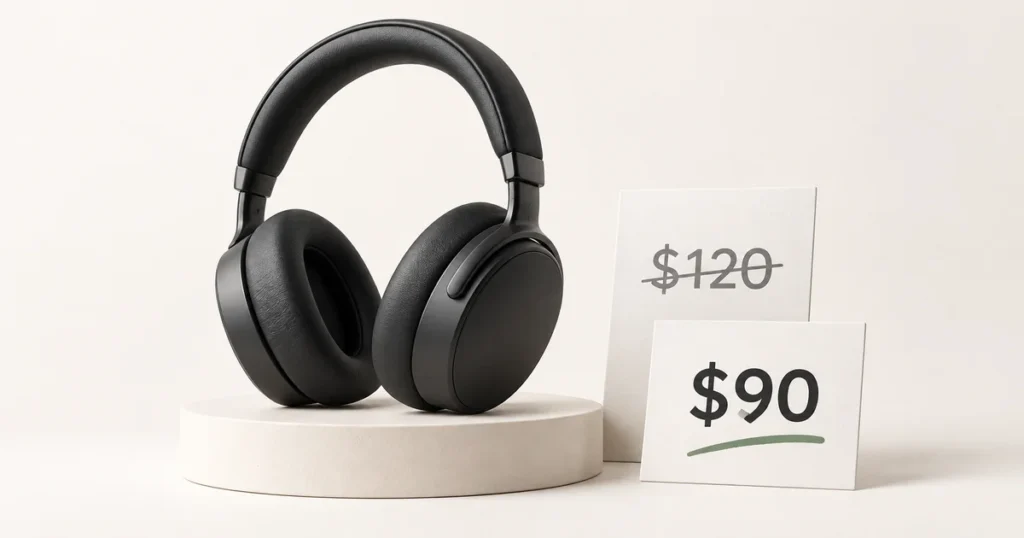
Price anchoring is the influence a reference price has on how a buyer judges another price. A product offered at $90 can look different beside a previous price of $120, a premium alternative at $180, or an equivalent offer at $85. The selling price stays the same; the comparison changes.
For retailers, the useful question is what the reference means. Was it your real earlier price? A manufacturer’s suggested price? The price of a different model? Each tells the buyer something different. Each needs a clear label and evidence to support it.
Key takeaways
- A reference price can influence perceived value without changing the product or its current price.
- Your former price, MSRP and a competitor’s price support different comparisons. They are not interchangeable.
- A large displayed saving does not prove that an offer is cheaper than available alternatives.
- Keep evidence for the reference price and test the presentation without inventing a higher anchor.
What a reference price actually tells the buyer
A reference price is a benchmark a buyer may use to judge another price. It can come from the page itself or from what the buyer recalls paying before. Prices seen at other stores can also serve as a reference. The number you show is one possible anchor, rather than the only one.
An external reference appears in the offer: a crossed-out price, an MSRP label, or another product’s price. An internal reference is the buyer’s own sense of what the item should cost. Someone who bought a similar item for $70 may judge your $90 price against that purchase, even if your page shows $120 as the comparison.
The label should explain the relationship between the two numbers.
| Reference shown | What it compares | What it does not establish |
|---|---|---|
| Your former price | The current offer with your own earlier offer | That the current price is the lowest available |
| MSRP or RRP | Your price with a manufacturer’s suggested retail price | That you previously charged it or that other retailers generally charge it |
| A competitor’s price | Your offer with a specified competing offer | That every seller charges that amount |
| A premium model’s price | Two different products or feature levels | A discount on the cheaper product |
Anchoring concerns how the benchmark affects judgment. To work out the amount after discounts, see list price vs net price. The math can be correct even when the reference has no sound basis.
What behavioral research supports
Lab studies have found that a starting number can affect what people say they would pay, even when it says nothing useful about the product. In one study, people were first asked whether they would buy goods at a price based on the last two digits of their social security numbers. They then stated the most they would pay. Those with higher starting numbers gave higher values.
The same research found that people could still rank products in a sensible order. For example, they valued a better wine more than a lower-rated one. Their answers could make sense relative to each other while starting from a level shaped by an unrelated number.
For an online store, this is a reason to review the comparison buyers see. It gives you no fixed rule for how much sales will rise or which crossed-out price works best. The study did not test your store, buyers or product page.
An answer shaped by an anchor is also not a fixed measure of demand. To learn what buyers would accept, use a separate willingness-to-pay research process and check the result against actual purchases.
Price anchoring examples and their different meanings
The prices below are hypothetical. They show what each comparison means. They are not results from a store’s sales campaign.
A genuine former price
A store previously offered headphones at $120 and now sells the same variant for $90. A clearly identified former price gives buyers a historical comparison: the store’s current asking price is $30 lower.
The earlier price needs a real history. Raising a price for a few days just to cross it out does not give it the same basis as a normal offer. Keep records of when buyers could buy at the earlier price and which terms applied.
U.S. guidance on former prices draws a line between real earlier offers and inflated prices created to make a bargain look larger. A completed sale at the old price is not required in every case. The offer still needs a sound basis, including how it was made and how long it lasted. Other markets have their own rules. No single number of days makes every former-price claim valid everywhere.
A manufacturer’s suggested price
A manufacturer suggests $120 for the headphones, and a retailer sells them for $90. MSRP means manufacturer’s suggested retail price; RRP means recommended retail price. Labeling the reference as MSRP tells the buyer where it comes from. “Was $120” would instead imply the store’s own price history.
A real MSRP can still be a poor guide to what other stores charge. If they normally offer the item around $90, the gap from MSRP does not show an unusual bargain. U.S. guidance also covers misleading savings claims where few actual sales in the relevant market take place at the suggested price. A correct label alone does not make every claim valid.
A real premium alternative
A range includes standard headphones at $90 and a premium model at $180. The premium price gives buyers a higher point of comparison, but it buys a different product. Show what the extra cost buys, such as less background noise, longer battery life or a longer warranty.
Both should be real offers at the stated prices. Make stock status clear too. If the premium model is out of stock, say so. Do not present it as a choice the buyer can order now.
The standard model is not “50% off” just because it costs half as much as the premium model. It is $90 cheaper than a different option. You would need a test to learn whether showing that gap helps sales. The gap itself does not prove an effect.
A specific competitor’s offer
A competitor offers the same new headphones at $105 while your price is $90. You can compare the two named offers if you have checked the exact model, variant and terms. Keep a dated record of what you checked.
It does not support “Other stores charge $105” if you checked only one seller. Another retailer might offer the same item for $88. A selected high price and a representative market comparison answer different questions.
If your team uses pricing intelligence for ecommerce, keep the seller, product and terms alongside each price. A number alone is not enough to support a claim buyers will see.
A bigger displayed saving can hide a higher buying price
Check what buyers will pay as well as the saving shown on the page. In this hypothetical example, both stores have the same new product and variant in stock. Prices use the same currency and include any tax due. Delivery is free.
| Offer | Displayed reference | Current payable price | Advertised saving |
|---|---|---|---|
| Store A | Its genuine former price of $120 | $90 | $30, or 25%, against its former price |
| Store B | No reference price shown | $88 | None stated |
Store A’s saving against its old price can be real, yet Store B is still $2 cheaper. A discount tells you the gap from its stated reference. It does not prove that an offer beats another store’s price.
Change the terms and the comparison can change too. If Store B adds an $8 delivery charge, its total becomes $96, with all other terms unchanged. If its price applies to refurbished stock, it is no longer an offer for the same new product.
Before using a competitor’s price as an anchor, check the variant, condition and pack size. Check stock and any charges the buyer must pay. Note when you saw the offer and keep claims up to date. For how often to check, see competitor price monitoring frequency.
How Shopify displays a comparison price
Shopify provides a practical example of the mechanism through its Price and Compare-at price fields. For a hypothetical sale at $90 against a genuine former price of $120, the values would be:
- Price: $90, the current selling price.
- Compare-at price: $120, the reference used for the sale display.
Compare-at price must be higher than Price for the sale price to display. Your theme controls where the store shows the comparison and how it looks. It can include a crossed-out price or a sale badge. Product and collection pages can show both amounts; checkout shows the sale price for this comparison.
Check the chosen variant and the collection card. If variants have different compare-at price settings, a collection page might not show the product as on sale.
These fields control the display. Entering $120 does not prove that buyers could buy at that price before, that the claim meets local rules, or that it helps sales. Keep evidence for the amount apart from the field that shows it.
Common price anchoring mistakes
Most avoidable mistakes give an anchor a meaning the evidence cannot support.
Inventing a former price
Start with the price history, then describe the saving it supports. Do not choose a high number just to create a larger saving. If you cannot support an earlier price, show today’s offer without claiming a drop from that amount.
Treating MSRP as the usual market price
A manufacturer’s suggestion can differ from what buyers normally pay. A saving against MSRP alone does not prove that your store beats the market. Check current offers for the same item before making that broader claim.
Comparing incompatible offers
A single item and a multipack can both have valid prices. So can standard and premium models, or new and refurbished stock. Keep those differences visible. Do not apply the reference for one version to another without checking its basis.
Letting labels and prices become stale
An expired offer is not a current competitor price. Repeated sales also need review: does a “regular” or “former” label still fit your records? When a campaign ends, check its price claims as well as its sale badge.
Adding several unexplained anchors
“Was $120,” “MSRP $130” and “Competitor $110” beside a $90 price each mean something different. All three could be correct, yet the buyer may not know which one supports the headline saving. Choose the reference that fits the claim. Label any extra comparison clearly.
Assuming a higher anchor always works better
The research gives no rule that raising a reference price will always help sales. Buyers can still judge the product, compare other offers and use prices they know. A test that records more orders cannot make an invented former price truthful.
Check the reference before testing the presentation
Keep a short record for each comparison you plan to use. Someone else should be able to check the amount and understand the claim without guessing.
- Identify the reference. Specify your former price, the manufacturer’s suggestion, a named competitor offer or a different product.
- Keep its support. Retain the relevant price history, manufacturer documentation or dated competitor observation, including conditions.
- Match the offer. Confirm the variant, condition, pack contents, currency and buyer eligibility.
- Write the label. State what the number represents and make material limitations visible beside the comparison.
- Set a review point. Recheck the reference when the campaign ends, the compared offer changes or the product configuration changes.
Once the basis is sound, test how clearly buyers understand it. Keep the selling price and the real reference fixed. You could compare a plain labeled price with the same facts shown in a different style, where both versions meet the rules for your market. Keep other factors, such as delivery terms, sales campaigns and stock, as stable as you can.
Track purchases and buyer questions. Use your own costs to assess contribution margin, too. More orders alone do not prove a better financial result. If you also change the selling price, the test measures both changes rather than anchoring alone.
A useful price anchor gives the buyer a comparison they can understand and the retailer a claim it can support. Start with the evidence behind the reference, then decide how to display it.
See how your own catalog compares with the market
SkuPeek finds matching competitor offers and compares their prices and availability with your products.