
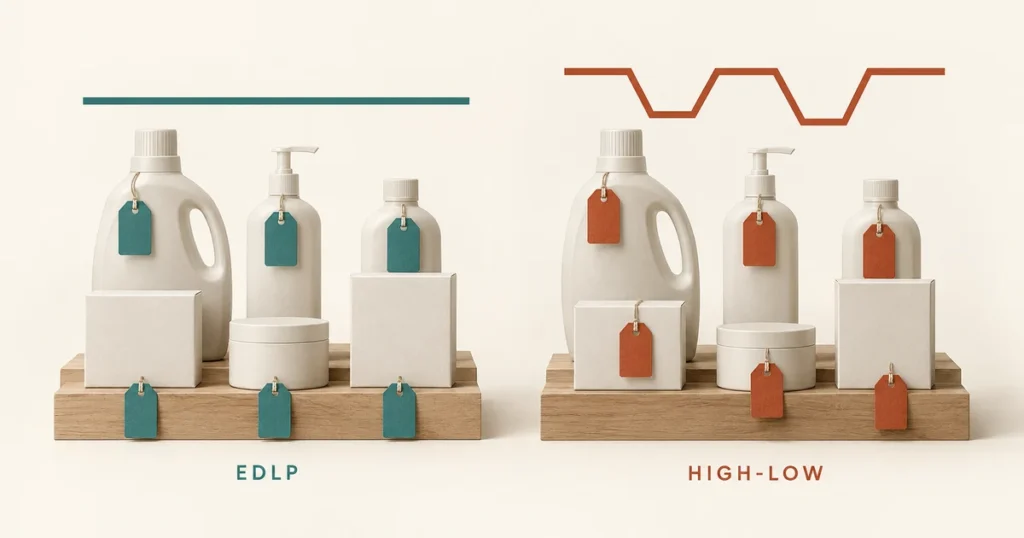
EDLP means everyday low pricing: a retail policy built around consistently low regular prices, with less reliance on frequent, deep discounts. Customers can buy at the regular price without waiting for the next sale. High-low pricing takes a different approach: a higher regular price alternates with temporary promotional prices.
For a retailer, this choice changes more than the price tag. A low regular price must cover the costs of buying and selling the product. It also needs enough sales over the full trading period. EDLP is one option within a broader set of ecommerce pricing strategies; its central test is whether the everyday price can support the business.
Key Takeaways
- EDLP makes the regular price the main value offer.
- An EDLP price can be higher than a rival’s temporary sale price. It is not a promise to win every price comparison.
- Fewer promotions only help the economics if the business actually saves money or sells enough additional units.
- Compare EDLP and high-low over the same period, including full-price sales, sale-price sales, and the costs of each policy.
Jump to the policy comparison, 12-week calculation, or transition test.
What is EDLP?
EDLP is a lasting approach to regular prices. The price available on an ordinary shopping day should be competitive enough to support the retailer’s low-price position without a constant cycle of large discounts.
The acronym also appears as “everyday low price” or “every day low prices.” In retail, these forms describe the same broad pricing approach. The important distinction is between the normal price customers can buy at and a temporary price available during a sale.
Consider a household refill sold at $18 as its ongoing regular price. If the business can maintain that offer through its costs and trading model, it could form part of an EDLP policy. Selling the same refill at $18 for its first month before moving to $24 serves a different purpose. A low introductory price used to enter a market belongs to penetration pricing.
EDLP also needs a defined scope. A store can apply it to a replenishment range while using a different policy elsewhere. Describe that range clearly: keeping a handful of products cheap does not establish an everyday low-price position for the entire catalog.
EDLP vs high-low pricing
The main difference is where the retailer puts its value offer: in the regular price, or in recurring discounts from a higher regular price. Both policies need sufficient demand and a workable cost structure.
| Decision | EDLP | High-low pricing |
|---|---|---|
| Regular price | A sustained low everyday price | A higher price between promotions |
| Major promotions | Less central to the policy | A recurring part of the policy |
| Purchase timing | The regular offer gives shoppers a reason to buy now | A sale window gives shoppers a reason to act |
| Price comparison | Assess the regular offer over time | Assess both regular and promotional offers |
| Economic test | Can regular-price sales support the business? | Can the full-price and discounted sales mix support the business? |
A high-low promotion can undercut an EDLP price. An $18 everyday offer could sit below a competitor’s $22 regular price but above its $16 sale price. The EDLP policy remains distinct because the $18 offer is available between sale events.
Neither the lowest sale price nor the regular price alone tells you which policy earns more. The outcome depends on how many units sell at each price and what the business spends to support those sales. The separate promotional pricing guide covers evaluating an individual campaign; the EDLP decision concerns the continuing price structure.
What makes a low regular price sustainable?
A low regular price needs enough money left after variable costs to cover the continuing costs of the business. More orders cannot repair a negative contribution on every additional sale.
Start with what you spend to buy and sell each unit: stock, freight, payment fees, picking, packing, any delivery cost you cover, and expected returns. If a fee is a share of the selling price, calculate it at each price. If a cost is per order, allow for the units in that order. A cost-plus pricing calculation can help establish the cost base.
Then list the costs of running the pricing policy. These can include creating ads, media bought for sales events, display work, and price updates. Some could fall under EDLP. Others will remain: the store still needs shoppers, and staff time only becomes a cash saving when spending actually falls.
Supplier terms deserve a separate check. A supplier might fund temporary discounts without offering the same support for a lower regular price. Model the net acquisition cost available under each policy. Do not count a supplier allowance twice as both a lower unit cost and a separate promotion benefit.
Check whether you can serve the extra sales, too. More units need more stock, handling, and cash tied up before the sales arrive. The price can work only if you can reach the required volume and keep costs under control at that level.
Which categories and conditions suit EDLP?
Test EDLP where people buy often, can compare like-for-like items, and you have a sound way to keep costs low. A category name by itself does not tell you whether the policy will work.
Household cleaners, pet supplies, and refill packs are examples worth testing. A shopper can compare the same size or pack each time. A reliable regular offer gives them a reason to return without waiting for a sale.
For an online store, include delivery fees, pack size, condition, and any rules about how much the shopper must buy. A low displayed price with a high delivery fee can weaken the value of the offer. Compare prices a shopper can actually buy on the same terms.
Walmart describes its approach as Every Day Low Prices. It links that policy to buying in bulk, working with suppliers, and moving goods through its supply chain. This explains its stated business model. Another retailer would need its own cost evidence before assuming it could achieve the same result.
Goods with a short selling season need a different test. A sale can help meet a stock deadline that a lower ongoing price does not address. If most of your shoppers arrive for sales events, check how many will still buy between them before you remove those events.
Does EDLP mean prices never change?
EDLP does not require a price to stay unchanged forever. A lasting rise or fall in buying or shipping costs can be a reason to change the regular price. The key is the store’s ongoing price position and the role that sales events play.
Set clear rules for changes to the regular price and for short-lived offers. A cost saving could fund a new, lower everyday price. A sale of stock you no longer plan to carry could sit outside the core policy. Define the exceptions so the team knows which items and dates they cover.
Walmart’s own description includes targeted Rollback price cuts alongside its EDLP commitment. This shows that an everyday-price policy can include further cuts.
The boundary becomes harder to defend when deep discounts happen so often that shoppers have little reason to pay the regular price. Check the actual offer pattern, not just its label. If the business still depends on repeated sales events, include that demand in the cost and sales comparison.
A 12-week example: EDLP and high-low economics
A lower everyday price must earn back any lost unit contribution through real cost savings, additional sales, or both. The following example compares the two policies for one hypothetical product.
Both policies cover the same 12 weeks, product, pack size, condition, and delivery terms. All amounts are in USD, excluding sales tax. Variable cost is assumed to remain $14 per unit, including the product and the costs of serving the sale. Other fixed overhead is unchanged and excluded.
The high-low scenario assumes 100 units per regular-price week and 200 per promotion week. The EDLP comparison starts with the same total volume to isolate the effect of price and policy costs. These are assumed sales volumes, not measured demand responses.
The hypothetical pricing-policy budgets for this SKU over the 12 weeks are:
- High-low: $1,200. This comprises $600 in promotion-specific advertising, $300 in paid campaign creative and setup across the three promotion weeks, $150 in routine price checks, and $150 in price-page maintenance.
- EDLP: $300. The same $150 in price checks and $150 in price-page maintenance remain; the promotion-specific advertising and creative costs are removed.
The $900 saving therefore comes from the two campaign expenses. These fixed period budgets are excluded from the $14 per-unit cost of buying and serving each sale. They are deducted once below the unit contribution calculation. Broader store advertising and other unchanged overhead remain outside this comparison.
| Input or result | High-low scenario | EDLP scenario |
|---|---|---|
| Regular price | $22 | $18 |
| Weeks at regular price | 9 | 12 |
| Promotion price | $16 | None |
| Promotion weeks | 3 | 0 |
| Units at regular price | 900 | 1,500 |
| Units at promotion price | 600 | 0 |
| Total units | 1,500 | 1,500 |
| Variable cost per unit | $14 | $14 |
| Period pricing-policy costs | $1,200 | $300 |
| Revenue | $29,400 | $27,000 |
| Contribution before policy costs | $8,400 | $6,000 |
| Contribution after policy costs | $7,200 | $5,700 |
For high-low, contribution after policy costs is:
900 × ($22 − $14) + 600 × ($16 − $14) − $1,200 = $7,200.
For EDLP at the same volume, it is:
1,500 × ($18 − $14) − $300 = $5,700.
The assumed $900 saving in policy costs does not cover the $2,400 reduction in contribution before those costs. EDLP finishes $1,500 behind in this comparison. These figures are contribution after the specified costs, not net business profit. The contribution margin guide explains what remains to cover overhead.
How much volume would EDLP need?
At $4 contribution per unit, the EDLP scenario needs to cover its $300 policy cost and match the high-low scenario’s $7,200 result:
Required units = ($7,200 + $300) ÷ ($18 − $14) = 1,875.
That is 375 additional units, or 25% more than the 1,500-unit comparison volume, over the same 12 weeks. It is a requirement from the arithmetic, not a prediction that lowering the price will produce those sales. It also assumes the stated unit and policy costs hold at the higher volume.
What if EDLP actually lowers unit costs?
Suppose a confirmed supplier or operating saving reduces EDLP’s variable cost from $14 to $13. At the original 1,500 units, its result becomes:
1,500 × ($18 − $13) − $300 = $7,200.
In that separate scenario, EDLP matches high-low without additional volume. The $1 reduction is hypothetical and separate from the policy-cost saving already included.
Under these assumptions, the retailer should not switch this SKU to EDLP at the current 1,500-unit sales volume and $14 variable cost. The change becomes economically competitive at a minimum of 1,875 unit sales with that $14 cost, or at 1,500 sales with variable cost reduced to $13 per unit, with the other assumptions unchanged.
Also use units, rather than weeks, to calculate high-low’s average selling price. Here, revenue of $29,400 divided by 1,500 units gives $19.60. Weighting prices only by the nine regular and three promotion weeks would ignore the extra units assumed to sell during promotions.
How to test a move from high-low to EDLP
Test a defined product range against a baseline that includes the full high-low cycle. Check whether the lower regular price leaves enough money to support the business, and whether shoppers keep buying as you reduce recurring sales events.
- Choose the scope. Identify the products, channels, and customer offer covered by the everyday-price policy. Keep clearance and other exceptions explicit.
- Build the baseline. Include regular weeks, promotion weeks, and the period after promotions. Record units and actual selling prices, net supplier support, variable costs, and attributable policy costs.
- Calculate what the plan needs. Work out the units needed to match the baseline result. Keep confirmed cost changes separate from hoped-for savings. Check how much stock, handling, and cash those sales would need.
- Keep a useful comparison. Use similar products or stores where practical. Record changes in season, stock, spending to attract shoppers, and rival offers. A rise in sales after the change does not by itself prove that EDLP caused it.
- Set review rules in advance. Decide the contribution target, how much cash you can commit, and when you would review the price or scope. Include the cost of explaining the new offer to shoppers.
Check category contribution and basket mix alongside the SKU result. A promotion can shift demand between products or bring purchases forward when shoppers stock up, leaving fewer purchases in later weeks. Include the weeks after promotions so higher campaign sales are not treated as lasting category growth.
Keep checking equivalent rival offers during the test. Use a competitor price monitoring frequency suited to the category. Check whether a rival’s lower price is a brief sale or a lasting change to its regular price.
A stronger sales week is only one part of the test. Look for an offer shoppers keep buying, enough contribution over the full period, and costs you can maintain. If the required volume or savings do not arrive, revise the price or scope before you extend the policy.
See how your own catalog compares with the market
SkuPeek finds matching competitor offers and compares their prices and availability with your products.