
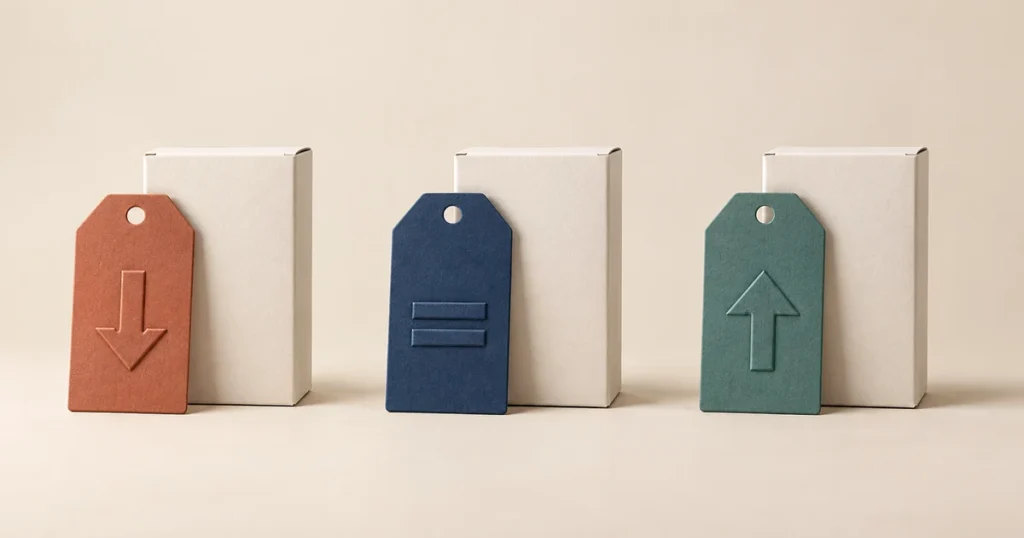
A competitive pricing strategy uses the public prices of comparable offers to guide your own pricing decisions. Match when price is a credible reason customers choose another seller and the economics support a change. Hold when the competing offer is irrelevant, the evidence is weak, or matching would breach your cost limits. Maintain or test a higher price when customers have a reason to prefer your offer and purchasing evidence supports the difference.
The useful output is a policy your team can apply to a particular SKU: which competitors matter, what would justify a response, and where you stop. A cheaper rival does not tell you how much demand you would gain by following it.
Key takeaways
- Assign a competitive position to each product group before responding to individual price changes.
- Make matching conditional on both a relevant competing offer and a minimum contribution per sale.
- Treat holding as an explicit decision with a reason and a review trigger.
- Test a premium against total contribution and customer response, including the cost of any extra service.
Define the competitive position before the next price change
Decide which role competition plays for each product group. A widely compared branded item can warrant a tighter price position than an item bought mainly for immediate local availability or specialist support.
For a product customers routinely compare across sellers, your policy might aim to stay close to a small, approved competitor set. For a service-led offer, it might allow a premium while specified service standards and commercial results hold. Neither policy has to apply to your entire catalog.
Write that position before a rival changes its price. Otherwise, the latest low offer becomes the target by default, even if it comes from a seller your customers rarely consider.
Cost-based calculations help establish what you need to recover. Customer value helps assess what a buyer could accept. Competitive pricing supplies an external reference for the decision. For choosing between broader approaches, see the overview of ecommerce pricing strategies.
Specify which competing offers can trigger a response
Only let an eligible offer trigger your policy. Keep the eligibility rule brief enough that the person approving a price can apply it consistently.
Define the product and variant, condition, pack quantity, market, currency, availability, delivery charges and purchase conditions. Compare the amount the same customer would pay on a consistent tax basis. A membership discount or minimum basket requirement needs its own treatment.
For example, an item at $114 with $8 delivery costs more to receive than your $120 offer with delivery included. Matching the rival’s headline price would create a further discount without matching its delivered total.
Choose the reference in advance: a named competing offer, the lowest eligible offer, or a defined benchmark across the approved set. Each answers a different question. Do not switch references simply because a different one makes the proposed action look better.
Keep collection and validation in your pricing intelligence workflow. This policy starts once the comparison is usable; its job is to decide what you do with it.
When to match or move below a competitor
Match when the customer can buy an equivalent offer for less, your competitive position calls for parity, and the lower price can meet your commercial target. All three conditions matter.
A lower competing price establishes a gap. It does not establish that the gap caused lost sales. Look for supporting evidence such as customers naming that offer when requesting a match, a controlled price test, or a sustained deterioration in purchases after a relevant competitor changed its price. Treat the last signal cautiously if traffic, stock or delivery also changed.
The scope of the response should follow the scope of the evidence. If the gap concerns one color or capacity, review that variant. Extending the cut to every variant gives away contribution on sales the original comparison did not address.
Matching and undercutting also require separate decisions. If parity removes the price disadvantage, going lower spends additional margin. Approve an undercut only when you have a specific reason to test it, sufficient room above your minimum contribution, and a way to judge whether the additional reduction earns its cost.
An individual price match and a public price reduction have different reach. A public cut affects customers who would have bought at the old price too. Include those sales in the calculation.
When to hold your price
Hold when there is no supported reason to change, or when the proposed response cannot satisfy your minimum economics. Record which reason applies, because each leads to a different next step.
| Reason to hold | What would reopen the decision? |
|---|---|
| The low offer fails your eligibility rule. | A current, eligible offer establishes a real gap. |
| One seller discounts, but its relevance to your customers is unclear. | Customer feedback or a focused test supports responding. |
| Matching falls below your approved contribution floor. | Costs fall, the offer changes, or an authorized exception has a separate business case. |
| Your current premium is supported by results. | Purchases, total contribution or service delivery weaken against the agreed target. |
Holding can be a temporary decision while evidence improves. Give it an owner and a review trigger so uncertainty does not turn into indefinite inaction.
It can also be the right response to a genuine competitive disadvantage. If another seller has a cost structure you cannot match, repeatedly cutting your price will not resolve yours. Review purchasing terms, fulfillment costs or whether the product still belongs in the assortment. A confirmed market price below your sustainable level is a commercial problem to address, even when a price cut is the wrong response.
When to charge more
Charge more when a buyer receives a difference that matters and the results justify its price. For the same branded product, that difference could be delivery speed, setup, support or returns service. Describe the actual benefit clearly enough that a customer can evaluate it before buying.
Distinguish preserving a premium from introducing one. If your current higher price already meets your targets, a cheaper rival is a reason to review that evidence. Raising the price further requires a fresh judgment about the likely loss of sales and gain per remaining order.
Consider a hypothetical $126 offer against a $120 comparable offer. If the higher price includes extra support, include the cost of that support in the evaluation. Calling it free does not remove the labor cost. If the service is optional, evaluate the base item and the service package separately.
Use purchase behavior to assess the proposed premium. Customer comments can help explain it, but favorable comments alone do not establish that customers will pay. The guide to willingness to pay covers that research question in more detail.
You can also raise a price while remaining below competitors. That is a move toward parity, not evidence of a premium position. Evaluate it on its own economics rather than assuming every increase requires a new service benefit.
Calculate what each response must earn back
Compare the total contribution each option would need to produce. A price reduction can require a much larger percentage increase in unit sales than the percentage cut itself.
The following figures are hypothetical. Assume one SKU sells 200 units per review period at $120, excluding tax. Variable costs total $78 per unit, including the product and variable selling costs. For this simplified comparison, those costs stay unchanged across all three prices. There are no extra campaign or service costs, and fixed overhead stays the same.
The current price leaves $42 per unit, or $8,400 in total contribution. This is the amount available toward fixed costs and profit, not net profit. For the underlying cost classification, see contribution margin.
| Decision | Selling price | Contribution per unit | Units to reach $8,400 |
|---|---|---|---|
| Match a lower eligible offer | $114 | $36 | 234 |
| Hold the current price | $120 | $42 | 200 |
| Test a higher price | $126 | $48 | 175 |
At $114, the price falls 5%, but contribution per unit falls from $42 to $36. Dividing $8,400 by $36 gives 233.33 units. You need 234 whole units, or 17% more than the baseline, to reach at least the same contribution. At 233 units, you remain slightly short.
At $126, you need 175 units to preserve the same contribution. That permits a 12.5% decline from 200 units under these assumptions. It does not predict that the actual decline will stay within that limit.
This comparison assumes the 200-unit baseline remains a reasonable estimate of sales if you hold. If the rival’s lower price would reduce your unchanged-price sales, use that revised baseline too. For example, 180 units at $120 yield $7,560; matching at $114 would need 210 units to equal it. Keep the forecast separate from the observed historical result.
Your contribution floor is a separate constraint. If you require at least $30 per unit with these same $78 variable costs, the minimum permitted price is $108. A rival at $105 would leave $27. That is positive contribution, but it fails your policy. The $108 limit is a management requirement in this example, not proof that fixed overhead will be covered.
Before using the comparison in practice, recalculate percentage-based fees, returns, shipping subsidies and any extra selling or service costs at the proposed price. Compare scenarios when demand is uncertain. None of these calculations reveals a competitor’s costs or predicts your sales response.
Turn the decision into a repeatable rule
Write a short rule for each product group that makes approval and reversal clear. The rule should connect an eligible competitive signal to an action, subject to your cost and evidence limits.
A hypothetical policy for the SKU above could read:
Position: Stay close to approved competing offers for this exact variant in this market.
Review trigger: An eligible delivered price moves more than 3% below ours. The 3% threshold is an internal starting assumption, not an industry standard or an automatic price cut.
Approval condition: The proposed price leaves at least $30 contribution per unit, and the sales requirement is credible against the expected outcome of holding.
Default under uncertainty: Hold while the assigned owner checks the evidence. Escalate if the competitive disadvantage persists.
Exit condition: Revert or revise the response when it misses the agreed commercial target, or the offer that justified it ceases to qualify.
Set the review window before applying the change. It needs enough comparable purchases to judge the result and enough time to include relevant returns or service costs. Use the separate guide to competitor price monitoring frequency to plan observation timing; keep price approval tied to the policy.
Measure total contribution alongside units, conversion and customer outcomes. A before-and-after improvement is not enough to establish causation if advertising, availability or seasonality changed. Where a comparable control is practical, use it. Otherwise document the other changes and keep conclusions limited.
Make pricing decisions independently. Public competitor prices can inform your internal policy; they are not an invitation to agree future prices with other sellers. Supplier pricing terms require separate review: in the US, suggested retail prices and manufacturer-imposed restrictions are distinct issues, and federal, state and international rules can differ. See the FTC’s guidance on manufacturer-imposed requirements.
For each decision, retain the eligible offer, the approved price, the cost assumptions, the expected result and the reason to review it. That record makes it possible to explain why one SKU was matched, another was held, and a third kept its premium.
See how your own catalog compares with the market
SkuPeek finds matching competitor offers and compares their prices and availability with your products.