
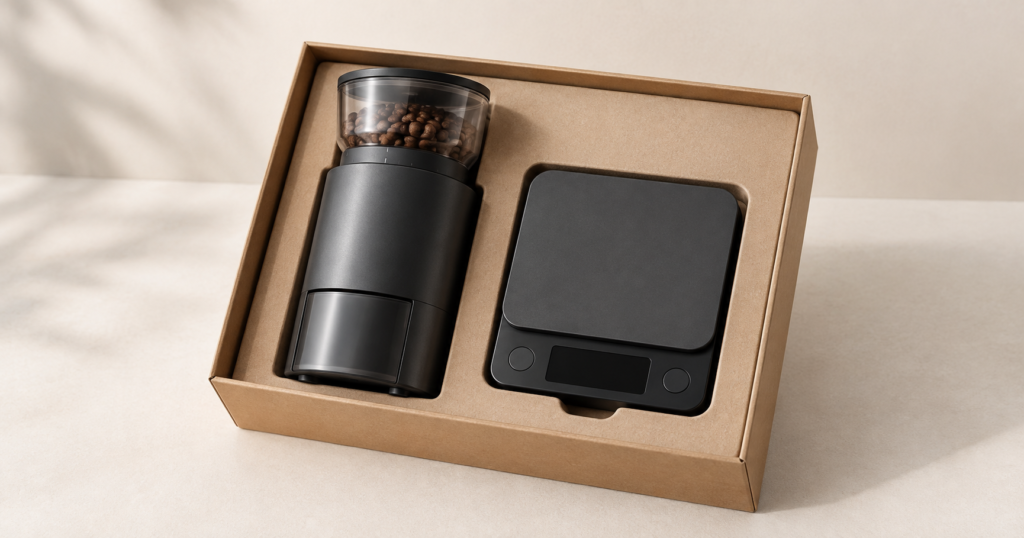
Bundle pricing means selling two or more products together for one price, often below their combined individual prices. To set that price, define the exact contents, calculate the separate purchase total, and subtract every variable cost from the amount you will collect. Then check what the customer would otherwise have bought.
In a hypothetical coffee example, a $108 bundle offers a 10% discount and leaves $35 in contribution. Whether that is an improvement depends on the comparison: the same two products at full price, or just the main product. Those two baselines lead to different decisions.
Key takeaways
- Calculate the discount against the same products, variants and quantities sold separately.
- A larger order can leave the same contribution as a smaller purchase.
- Include variable costs and permitted checkout discounts before choosing a price.
- Compare competing bundles only after checking every included component.
Pure and mixed bundling: what can the customer buy?
Pure bundling means the seller offers the products only as a package. A hypothetical gift kit sold exclusively as a complete set fits this model. Someone who wants only one item must buy the set or shop elsewhere.
Mixed bundling means the customer can buy the products separately or together. Selling a grinder for $90, scales for $30, and the pair for $108 is mixed bundling. It preserves the option to buy only what is needed, while making the combined purchase cheaper.
These terms describe buying options. They are separate from descriptions of the bundle’s contents:
- Fixed bundle: a predetermined set, such as one grinder and one set of scales, potentially with defined variant choices.
- Multipack: several units of the same product, such as three identical bags of coffee.
- Mix-and-match bundle: the customer builds the set from allowed products, such as choosing three different coffees.
A fixed bundle can use mixed bundling if its components are also sold individually. “Mixed” does not mean “mix-and-match.”
Price bundling also differs from captive-product pricing. Selling a coffee machine together with pods is a bundle. Selling the machine and relying on later purchases of required compatible pods is a separate pricing relationship. For a broader comparison of pricing approaches, see our ecommerce pricing strategies guide.
A bundle pricing example: one grinder and one set of scales
This hypothetical example uses US dollars. Each complete bundle contains one grinder and one set of scales, with identical models and variants across comparisons. Modeled variable costs total $73 per set. Tax and delivery charges are excluded.
| Component | Price if bought separately | Assumed variable cost |
|---|---|---|
| One coffee grinder | $90 | $55 acquisition cost |
| One set of scales | $30 | $15 acquisition cost |
| Additional bundle assembly and packaging | — | $3 |
| Total | $120 | $73 |
Set the bundle price at $108. First calculate the customer’s saving, then calculate what remains after the modeled variable costs.
| Calculation | Formula | Result |
|---|---|---|
| Saving on the same basket | $120 − $108 | $12 |
| Bundle discount | ($120 − $108) ÷ $120 × 100 | 10% |
| Contribution per bundle | $108 − $73 | $35 |
| Contribution margin | $35 ÷ $108 × 100 | 32.41% |
The discount uses the separate purchase total as its denominator. Contribution margin uses the bundle’s selling price. Dividing $35 by the $73 cost would calculate markup on the modeled cost, a different measure.
Contribution in this article = selling price − modeled variable costs. It is not net profit: fixed expenses remain to be covered.
Add the costs your business actually incurs
The $73 covers only the costs in the table. Add applicable payment fees, marketplace commissions, fulfillment, seller-funded shipping and expected return losses, counting each expense once.
If those additional expenses total a hypothetical $5 per bundle, cost becomes $78 and contribution becomes $30: $30 ÷ $108 × 100 = 27.78% contribution margin.
Recalculate price-dependent fees when the selling price changes. Allow for refunds and any recovered value when estimating return losses.
Compare the bundle with two different purchases
The relevant baseline is what the customer would have bought without the bundle. Use both scenarios before deciding which behavior to test.
Baseline 1: the same basket at separate prices
Hold the contents and variable costs constant: one identical grinder, one identical set of scales, and the same $3 assembly and packaging allowance. At the combined separate prices of $120, contribution would be:
$120 − $73 = $47 per order.
Charging $108 reduces that contribution to $35. The $12 reduction is 25.53% of the original $47 contribution, even though the customer receives a 10% price discount.
To preserve total contribution solely by selling more of these complete sets, with unit costs unchanged:
Required order-volume ratio = $47 ÷ $35 ≈ 1.343.
That means approximately 34.3% more complete-set orders. This is an arithmetic threshold, not a sales forecast or evidence that customers will respond to the offer.
The comparison deliberately holds costs at $73 to isolate the price change. If selling the items separately avoids bundle packaging or creates different fulfillment costs, replace the baseline with those actual costs.
Baseline 2: the grinder alone
Now change the purchase explicitly: the customer buys one $90 grinder, with its modeled $55 acquisition cost and no additional bundle packaging. Before any other variable expenses, contribution is:
$90 − $55 = $35.
Moving that purchase to the $108 bundle adds $18 in revenue. It also adds $18 in modeled cost: $15 for the scales and $3 for assembly and packaging. Contribution stays at $35.
The order value is 20% higher in this scenario, but contribution per order is unchanged. This is not a measured increase in storewide average order value.
These scenarios show why the starting purchase matters. Customers switching from the full-price pair would reduce contribution per order; customers switching from the grinder alone would leave it unchanged in this model. Neither switch has been observed here. Cannibalization remains a possibility to measure, not a proven outcome.
Set a price that meets your contribution requirement
A target contribution margin can help screen a proposed bundle price. With a fixed dollar amount of variable cost per bundle:
Required price = variable cost ÷ (1 − target contribution margin).
For a hypothetical 30% target and the original $73 cost model, the result is $73 ÷ 0.70 = $104.2857…. Rounded up to cents, $104.29 meets that target before omitted costs or additional discounts.
With the expanded $78 cost estimate, the same calculation gives $78 ÷ 0.70 = $111.4286…, or $111.43. The proposed $108 price no longer meets the target.
This calculation sets a cost-based boundary. It does not establish what customers will pay. If the acceptable customer price falls below your required contribution, reconsider the discount, component costs or bundle contents.
Check how many complete bundles you can fulfill
Available component stock limits how many complete sets can ship. In the hypothetical store’s internal inventory, assume 12 grinders and 7 sets of scales are confirmed available, inventory is tracked, and backorders are disabled.
One bundle needs one of each, so the store can assemble 7 bundles.
For other quantities, divide each component’s available stock by the quantity needed per bundle, round down, and take the smallest result. Two grinders per bundle would make the same stock sufficient for only 6 bundles.
Keep reservations and standalone sales reflected in those available quantities.
These are internal warehouse quantities. A competitor’s public “in stock” label does not reveal how many complete sets it can supply.
If you use Shopify Bundles: Review component inventory settings before displaying a bundle quantity. Product- or collection-specific discounts must include the parent bundle product. Component price changes do not automatically update the bundle price, so review it separately. These rules are specific to the Shopify Bundles app.
Compare the whole bundle with competitors
A competitor selling the same grinder does not automatically offer a comparable bundle. Verify the complete set before using its price as a benchmark:
- Match the grinder model and variant, including relevant specifications such as voltage.
- Match the scales model and the quantity of every component.
- Check included accessories, product condition and warranty terms.
- Use the same currency, tax and delivery basis, and record any coupon or membership conditions.
If the competing offer contains different scales or omits them entirely, record that difference. Leave the direct price comparison unresolved when the contents are unclear. A similar photograph or the phrase “coffee starter kit” is insufficient evidence.
For a predefined physical assortment, changing, adding or replacing an included product requires a new Global Trade Item Number (GTIN) for the assortment under GS1 rules. This does not mean every virtual shopping-cart bundle has its own GTIN. Even where an identifier is present, verify the listing contents because seller data can contain errors.
Treat this as a product matching check before making a pricing decision. When collecting offers through price scraping, retain the component details and purchase conditions alongside the displayed amount.
Common bundle pricing mistakes
Treating the advertised discount as the final discount
Suppose an eligible additional 5% discount applies to the $108 coffee bundle at checkout, with no other items in the cart. The customer pays $102.60. Against the same $120 basket, the total saving is 14.5%, and contribution falls to $29.60 if variable costs remain $73.
This calculation assumes the extra 5% applies to $108. Discount combinations depend on your platform and settings; test the actual cart with all permitted codes and automatic discounts.
Advertising a saving against an outdated basket
The $120 reference depends on the grinder costing $90 and the scales costing $30 separately. If either price changes, recalculate the saving using the exact same variants and quantities. For pure bundling, do not invent individual prices for items the seller never offers separately.
Judging success from bundle revenue alone
Track total contribution as well as bundle orders. Record sales of the components separately, realized selling prices, variable costs and returns over the evaluation period. A comparison group offered the standalone products can help assess what customers would otherwise buy; a simple before-and-after revenue increase does not isolate the bundle’s effect.
Using a bundle to force an unwanted add-on
A discount may have little value to someone who does not need the second item. Keep the buying task clear and consider a standalone option. Test demand for the combination before committing stock or packaging spend to a larger rollout.
Bundle Pricing Pre-launch Checklist
☐ Contents confirmed. Record every product, variant and quantity.
☐ Savings verified. Use the identical basket at current separate prices, or omit the savings claim.
☐ Contribution checked. Meet your target after all variable costs and permitted discounts.
☐ Stock available. Confirm complete sets using component quantities and inventory settings.
☐ Test defined. Choose the relevant purchase baseline; measure total contribution, standalone sales and returns.
Resolve any unchecked item before starting a limited test.
See how your own catalog compares with the market
SkuPeek finds matching competitor offers and compares their prices and availability with your products.